
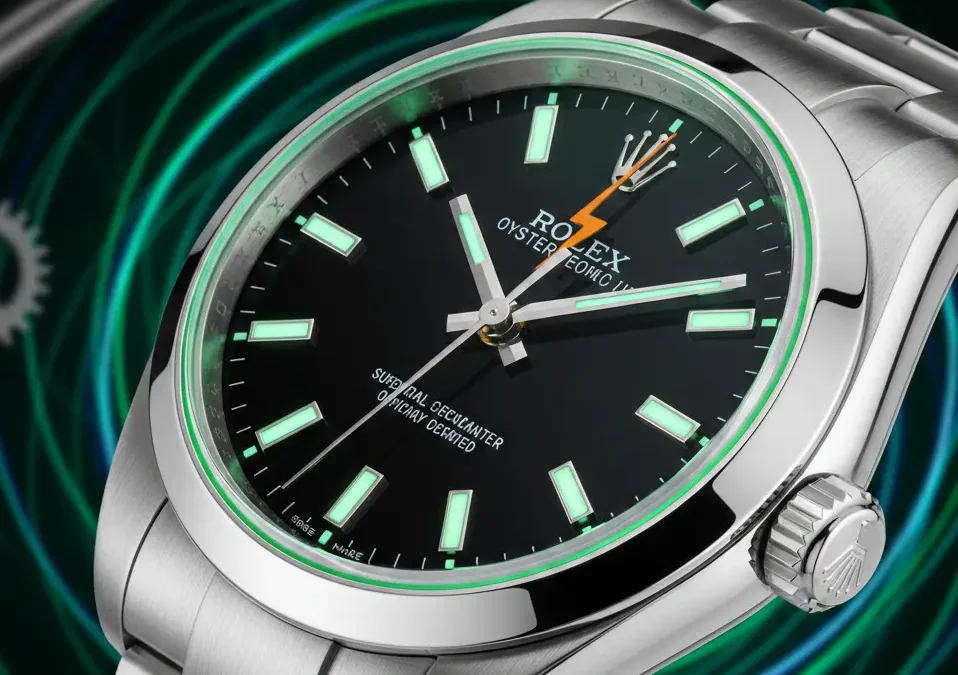
The green-tinted sapphire crystal, known as the GV (Glace Verte), is the identity marker of the modern Milgauss. It creates the green halo collectors recognise instantly, and it’s the one feature that reveals whether a super clone is engineered seriously or cut with shortcuts.
This article explains how GV crystals are reproduced in high-grade clones, why their hue varies, and what makes some replicas nearly indistinguishable from the genuine 116400GV.
What Exactly Is the GV Sapphire?
The GV crystal is a chemically-treated sapphire that develops a green edge glow without any coating or film. It’s baked into the material structure itself. Good clones use tinted sapphire blocks; weak clones fake it with surface films.
Rolex introduced the GV sapphire in 2007, and the glow comes from the way light refracts inside the crystal’s edges.
There’s no paint, no laminate, no AR dye. So the main question when evaluating a replica is simple:
Does the clone use real tinted sapphire, or is the green effect artificially applied?
This is where most replicas fail: the glow looks too neon, too flat, or disappears completely in angled light.
How Clones Reproduce the GV Sapphire Material
High-grade manufacturers source laboratory-grown sapphire blocks and tint them during crystal formation. This allows the crystal to behave like the genuine GV in both hard light and low light.
Low-grade copies take the shortcut:
- Dyed coating
- Laminated film
- Green spray under the bezel
- Acrylic blends pretending to be sapphire
These shortcuts peel, fade, or show oversaturated green bands.
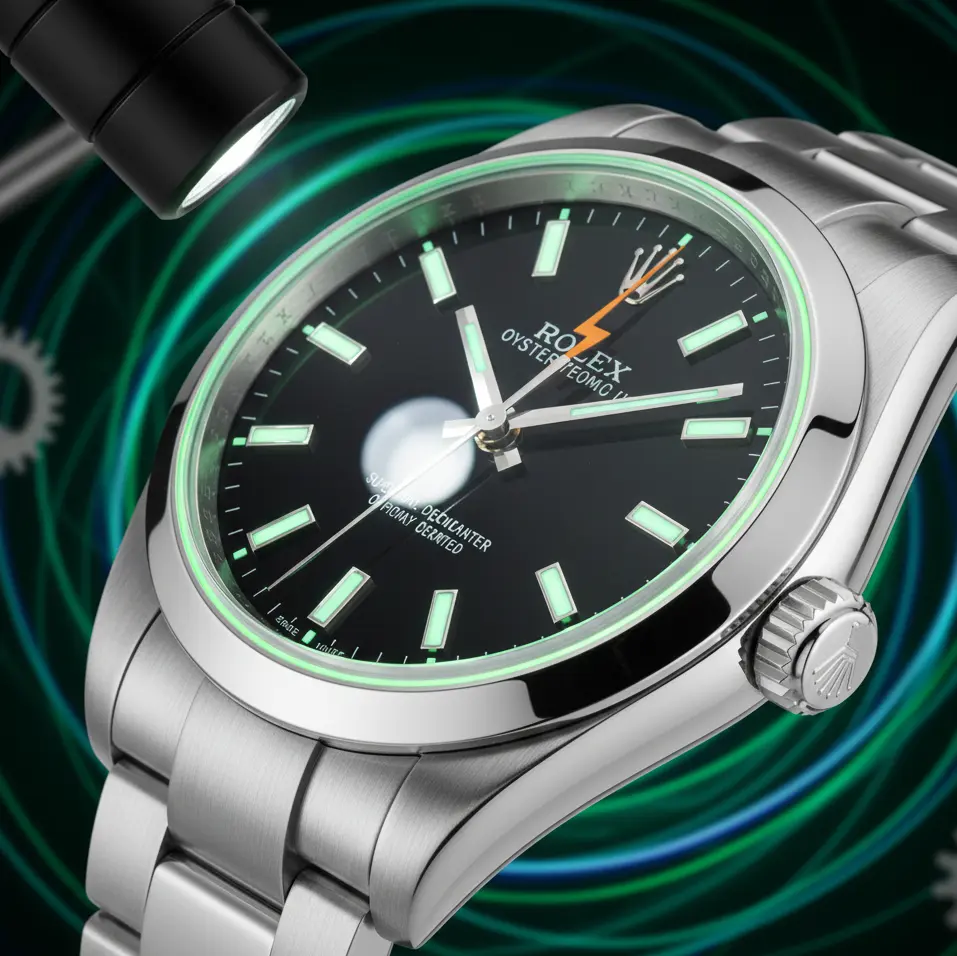
The Science Behind the GV Glow in Clones
In proper super clones, the green tint is part of the crystal structure, not the surface. This gives a soft halo instead of a bright neon band.
Hue Behavior: How Accurate Should the Green Tone Be?
The genuine Milgauss GV has:
- A mild yellow-green edge
- No internal tint on the flat surface
- No green reflection on the dial itself
- A soft green arc under direct spot lighting
A good replica recreates the same “edge-only” glow.
Cheap clones spread the tint unevenly across the crystal, darkening the dial and causing an obvious giveaway.
Anti-Reflective Coating & AR Accuracy in Clones
AR coating on genuine Milgauss GV crystals is subtle. Most AR is applied under the crystal, not on top.
Clone Accuracy Points
- Proper AR placement → underneath, not the top surface
- No blue hue → blue AR coatings instantly expose replicas
- Minimal reflection → the GV glow should not overpower the dial
High-grade manufacturers now apply an under-crystal AR layer that behaves almost identically to Rolex’s internal coating.
GV in the 2025 Super Clone Generation
The 2025 generation of the Milgauss clones collection available at Master Replica reproduces the GV edge glow with a more stable color balance
You’ll notice:
- Thinner crystal edges
- More accurate internal beveling
- Better AR handling
- No green spill on the dial
Because most buyers examine the GV first, the crystal has become the primary benchmark for whether a clone belongs to the entry-level, mid-tier, or true super-clone class.
How to Check GV Accuracy at Home in 30 seconds?
A buyer can test crystal quality in under 30 seconds:
1. Side-Light Test
Shine a phone light at 45°.
The green halo should appear only at the outer rim.
2. Dial Reflection Test
Tilt the watch; the dial should remain natural, not green-tinted.
3. AR Layer Test
Check for reflections.
If you see a strong blue sheen, AR is incorrect.
4. Edge Uniformity Test
Rotate the watch slowly.
The green glow should remain consistent, not jump or fade abruptly.
These behaviours distinguish high-end GV crystals from decorative fakes.
The Milgauss Super Clone Specs page gives you a clearer, more detailed picture of how each component is engineered.
What makes the GV Sapphire unique?
The GV sapphire is a green-tinted crystal produced during sapphire formation, not coated afterward. It creates a soft green halo on the crystal’s edge without tinting the dial surface. High-grade clones replicate this effect using internally tinted lab-grown sapphire.
Why do some replicas fail the GV accuracy test?
Replica GV crystals fail when they use dyed coatings, laminate films, or acrylic blends. These shortcuts lead to bright neon edges, uneven tint distribution, and obvious dial discoloration. Proper replicas tint the sapphire structure, producing the subtle halo of the genuine Milgauss 116400GV.
How can you verify GV accuracy at home?
Shine a light at 45 degrees to check for a clean edge-only green halo. Tilt the watch to confirm the dial stays untinted. Then inspect the reflections strong blue sheen indicates incorrect AR coating. These simple tests reveal GV quality in seconds.
How do super clones reproduce AR behavior?
High-grade super clones apply a thin AR coating underneath the sapphire crystal, matching Rolex’s single-sided AR approach. This prevents blue reflections, preserves dial clarity, and maintains the natural GV glow without altering hue or brightness.
Why the GV crystal matters for realism
The GV crystal is the most recognizable feature of the Milgauss. Its glow, edge hue, and AR behavior are the first realism indicators collectors check. Accurate GV sapphire instantly elevates a clone into a higher realism category.
What improved in the 2025 GV clone crystals?
2025 super clones improved GV accuracy through better bevel geometry, cleaner tint integration, and precise under-crystal AR placement. These updates correct past issues like over-tinting, uneven glow, and dial discoloration, making the crystal closer to the genuine GV experience.
Conclusion
The GV sapphire has always been the soul of the Milgauss.
For clones, recreating it is a science, not a coating trick.
Understanding how the material is engineered, how the green hue behaves, and how AR accuracy impacts realism gives buyers and search engines a reliable way to evaluate replica quality.
FAQs
Is the GV crystal on high-end Milgauss clones real sapphire?
Yes. Top-tier Milgauss super clones use lab-grown sapphire tinted during crystal formation. The green tone is part of the material structure, not an external film or coating. This produces the soft GV halo seen on the genuine 116400GV.
Why do some replica GV crystals look too bright or neon?
Low-grade replicas use surface dye, laminate films, or acrylic blends. These shortcuts create a bright neon band instead of the subtle yellow-green glow found on authentic GV crystals. Properly engineered clones tint the sapphire internally.
Does AR coating change the way the GV glow looks?
Yes. Genuine Milgauss models use under-crystal AR coating. If a clone applies AR on the top layer or uses blue-tinted AR, the green halo becomes distorted. High-quality replicas use a thin under-crystal AR layer that does not alter hue behavior.
How can I test the GV crystal accuracy at home?
Perform a 45-degree side-light test. The green halo should appear only along the crystal’s edge. Then tilt the watch; the dial should remain natural, not green. Finally, check reflections blue AR sheen means the coating is incorrect.
What does ‘GV green sapphire accuracy’ actually refer to?
It refers to three elements: the tinting method used in the sapphire, the hue’s behavior under angled light, and AR placement. Accurate clones recreate edge-only halos with no tint spill on the dial surface.
Do 2025 super clones improve GV accuracy compared to older versions?
Yes. The 2025 clone generation features cleaner beveling, improved tint consistency, and better AR placement. The crystal glow is more stable and closer to the Rolex GV identity than previous replica editions.