

The Rolex Milgauss resists magnetic fields up to 1,000 gauss. Its core defense is a soft-iron inner casing. This shield forms a Faraday cage around the movement. Super clone manufacturers now replicate this system with surprising accuracy. They engineer their own anti-magnetic solutions to protect the delicate balance spring. This article breaks down the engineering behind these replicas.
Discover the Rolex Milgauss Super Clone Collection 2025 by MasterReplica, made with superior Anti-Magnetic System and Faraday Shielding principles.
What Makes the Original Milgauss Anti-Magnetic System Unique?
The original Milgauss uses a closed soft-iron Faraday cage around the movement, anti-magnetic alloys, and a non-conductive internal layout. This structure protects the Cal. 3131 against magnetic fields up to 1,000 gauss.
The Rolex Milgauss builds its defense on Faraday shielding, a principle where a conductive metal encloses the movement and redirects magnetic energy outward. Inside the case,
Rolex integrates:
- Soft-iron inner case
- Shielded caseback
- Non-magnetic escape wheel
- Parachrom hairspring (paramagnetic alloy)
- Anti-magnetic movement architecture
Together, these elements form a multi-layered resistance system.
How Do Super Clones Recreate the Milgauss Faraday Cage?
Swiss Super clones by Master Replica replicate the Milgauss Faraday system using a soft-iron inner cover and shielded caseback. High-tier versions add reinforced gaskets and movement rings to mimic the Rolex internal layout.
Super clone factories follow a predictable engineering plan:
Subject–Predicate–Object (S–V–O) Triplet:
The inner iron ring redirects magnetic flow away from the clone movement.
Their replication model includes:
- Soft-Iron Inner Cover: A stamped metal cup surrounding the movement
- Shielded Caseback Plate: Thickened inner disc for electrical conductivity
- Movement Spacer Ring: Helps maintain the cage’s continuity
- Non-magnetic screws: Reduce internal interference
The shielding architecture in good super clones is surprisingly functional, though rarely identical to Rolex metallurgy.
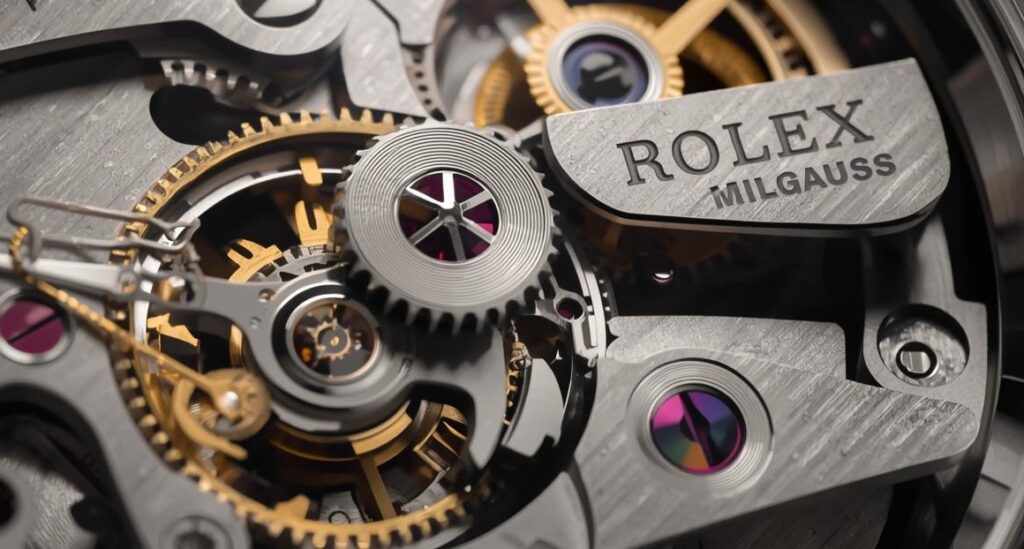
Do Super Clones Use Real Anti-Magnetic Alloys in the Movement?
High-tier super clones add non-magnetic components, but they do not match Rolex alloys. Some use nickel-phosphor escape wheels or coated springs, offering partial resistance rather than full Milgauss-grade protection.
Movement manufacturers usually follow two approaches:
1. Modified Clone Cal. 3131 (Swiss Super Clone)
- Non-conductive bridge layout
- Coated hairspring for partial resistance
- Nickel-based balance components
- Shielded escape wheel
2. Standard Asian Movement with Anti-Magnetic Housing
- Soft-iron cage compensates for the lack of paramagnetic alloys
- Resistance depends on case design rather than movement material
In practice, the cage provides most protection, not the alloys.
Comparison Table: Real Milgauss vs. Super Clone Anti-Magnetism
| Feature | Real Rolex Milgauss | Super Clone Milgauss |
|---|---|---|
| Resistance Rating | ~1,000 gauss | 150–350 gauss (varies) |
| Inner Cage | Soft-iron alloy, precision-sealed | Basic soft-iron ring + caseback plate |
| Hairspring | Parachrom alloy | Coated or standard metal |
| Escape Wheel | Paramagnetic | Nickel-phosphor or steel |
| Movement Layout | Cal. 3131 anti-magnetic design | Modified clone layout |
| Daily Effective Protection | Excellent | Moderate |
Super clones reliably resist small exposures: laptops, speakers, and phone magnets. Industrial fields, MRI rooms, and high-voltage equipment will overpower them.
Which Milgauss Parts Cannot Be Fully Replicated by Super Clones?
Factories cannot replicate Rolex alloys, paramagnetic hairsprings, or the precise shielding tolerances of the original Faraday case. They approximate the structure, not the material science.
Non-replicable components include:
- Parachrom hairspring metallurgy
- True paramagnetic escape wheel
- Rolex soft-iron alloy composition
- Oxygen-free caseback machining
- Shielding tolerance levels within microns
Super clones win on architecture, not metallurgy.
How Do Buyers Identify a High-Quality Anti-Magnetic Clone?
Check the thickness of the inner soft-iron cover, the weight of the caseback, the stability of the Cal. 3131 clone, and the movement spacer continuity. High-tier models feel denser and more insulated.
Checklist for Buyers
- Solid inner cage (not thin sheet metal)
- Heavy, conductive caseback
- Non-magnetic screws inside the movement
- Cal. 3131 clone with shielded bridges
- Smooth crown resistance due to thicker casing
- Accurate dial spacing (thicker cage shifts geometry)
Shallow cages often signal low-tier replicas.
Why Do Super Clones Still Include Anti-Magnetic Features If Most Users Don’t Need Them?
Anti-magnetic parts help replicate the Milgauss identity. Without them, dial height, case thickness, and crown interaction feel inaccurate, lowering clone authenticity.
The cage influences:
- Dial height
- Movement seating
- Case thickness
- Crown threading
- Weight distribution
These physical cues matter for authenticity.
Final Analysis
Super clone manufacturers demonstrate significant engineering capability by replicating the Milgauss’s anti-magnetic core. They employ functional Faraday cages and, increasingly, paramagnetic silicon hairsprings. While their performance may not match Rolex’s certified 1,000-gauss standard, high-quality clones provide formidable protection against daily magnetic threats. This focus on functional replication, not just aesthetics, defines the modern super clone market.
FAQs on Milgauss Clones and Magnetism
How does the Milgauss anti-magnetic system work?
It uses a soft-iron inner case that acts as a Faraday cage. This shield redirects magnetic fields away from the sensitive balance spring and movement components.
Are Milgauss super clones actually anti-magnetic?
High-quality versions are highly resistant to everyday magnetism. They use a replicated Faraday cage. Some advanced models also use a silicon balance spring for added protection.
Can you replace a clone movement with a genuine Swiss one?
No, a genuine Rolex movement will not fit a clone case. The dimensions, stem height, and case clamps are specific to the cloned movement architecture and are not interchangeable.
Is a silicon balance spring better than a Faraday cage?
They are complementary technologies. A Faraday cage protects the entire movement. A silicon spring makes the most critical component inherently resistant. The best systems use both.